

"Cells Finally Decided to Play Ball"
GG spelled this moments after I told her the news from her own iPSC neurons — the candidate we'd hoped for had given us the result we'd prayed for.
It's been a wild summer in GG's drug-development world. Upregulating a single good copy of a gene is an elegant idea — and, it turns out, a genuinely hard one, with all the challenges that come with drug discovery and the data needed to support an IND. But we've made real progress, and as we march toward the clinic, I wanted to share an update.
There are now hundreds of scientists and dozens of companies and institutions involved in building and delivering this ASO for GG.
September 18, 2026
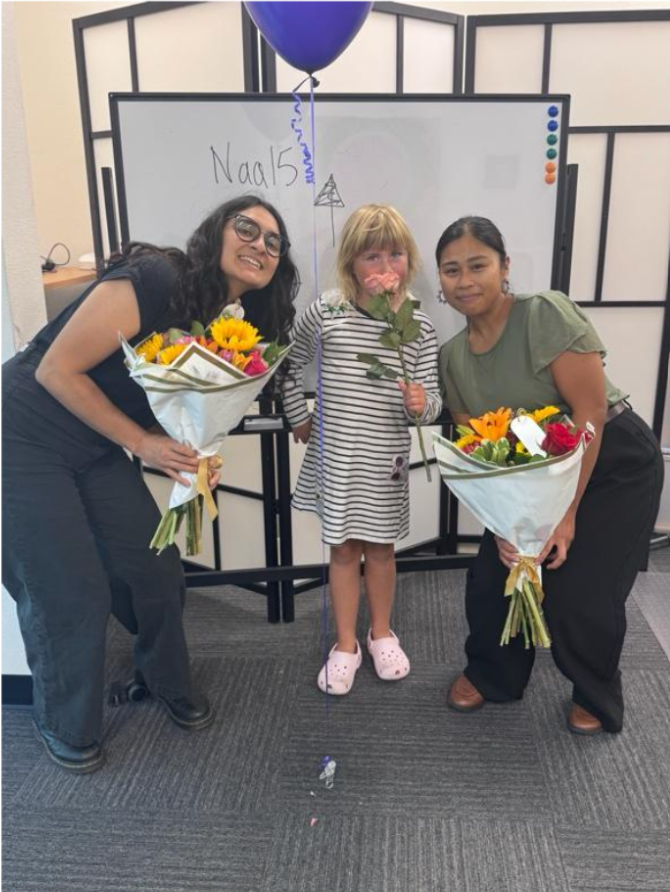
(GG with her lead scientists, Geramie Shaver and Perla (PJ) Sandoval)
One of the greatest strokes of fortune in this whole journey has been our paths aligning with Rady Children's and Dr. Olivia Kim-McManus — GG's primary investigator, treating physician, and future IND-holder. How she finds room in her schedule — as one of the most sought-after neurologists for children with genetic mutations, running brain studies, performing complex procedures, publishing, overseeing dosing, and rallying stakeholders across UCSD/Rady and beyond, all to treat one patient with one drug built just for them — is beyond me.
She ran a brain study for GG this past January that led to GG's epilepsy diagnosis and gave us a clearer picture of what's happening in her brain than we'd ever had. EEG will be one of the ways we watch for change once GG is dosed — a window into whether raising her NAA15 protein reaches the parts of her we can't see from the outside.
Every story published about Dr. Kim-McManus's patient outcomes gives us more hope for GG.
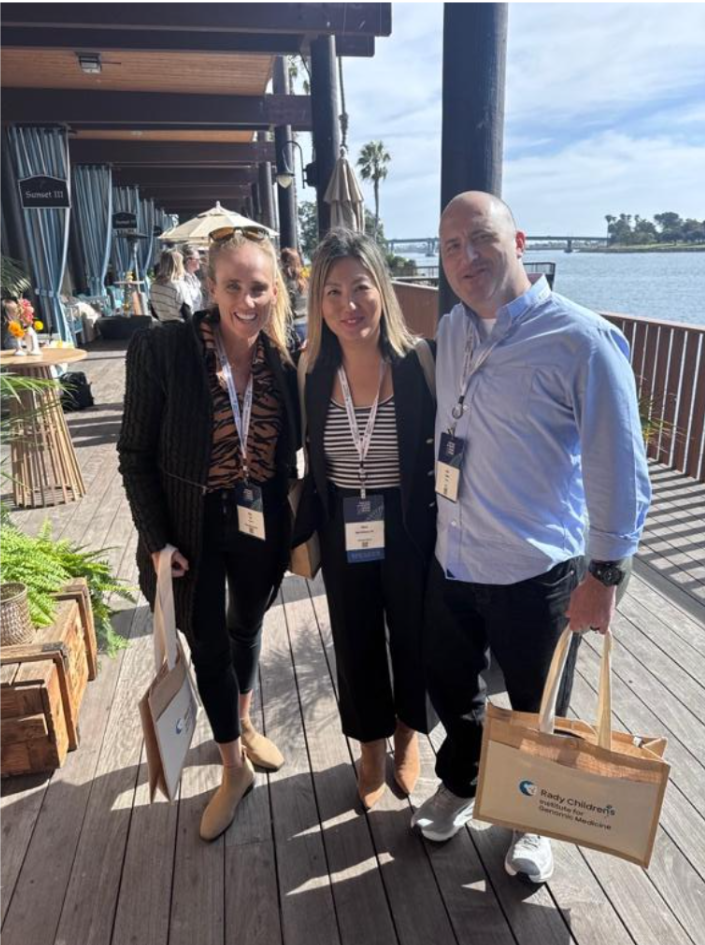
(Meg and Dr. Kim-McManus with Luke Rosen, parent ASO advocate and pioneer)
On the safety and pharmacology side…
We've formed a strong partnership with Charles River Laboratories, which has begun a five-week safety and tolerability study, with a robust bioanalytical package to follow. This work will, first and foremost, confirm the drug is safe and well tolerated—and help us set dosing and, if needed, further optimize our chemistry.
I attended their conference and their 30-year celebration this week and had the chance to speak about GG's story and the partnership. It was deeply emotional for me — and one of the moments I'll never forget was Dr. Lauren Black telling me she was "adopting GG and won't stop until we have a solution."
Knowing her work and her experience in this process, and how far we've come so fast, made it land even harder — just six months before I met Dr. Black, we were still being told we would never know the root cause of GG's complex medical picture, and that she would likely never be able to speak. Dr. Black and Dr. Mike Templin jumped in head-first — they even attended our pre-IND meeting with the FDA before I had signed a contract with them.
From an efficacy standpoint, we now have replicate data showing our ASO is doing what we hoped: raising NAA15 protein. We've seen it in an NAA15-normal cell line, in a CRISPR-engineered model of GG's mutation, and now in GG's own iPSC-derived cells.
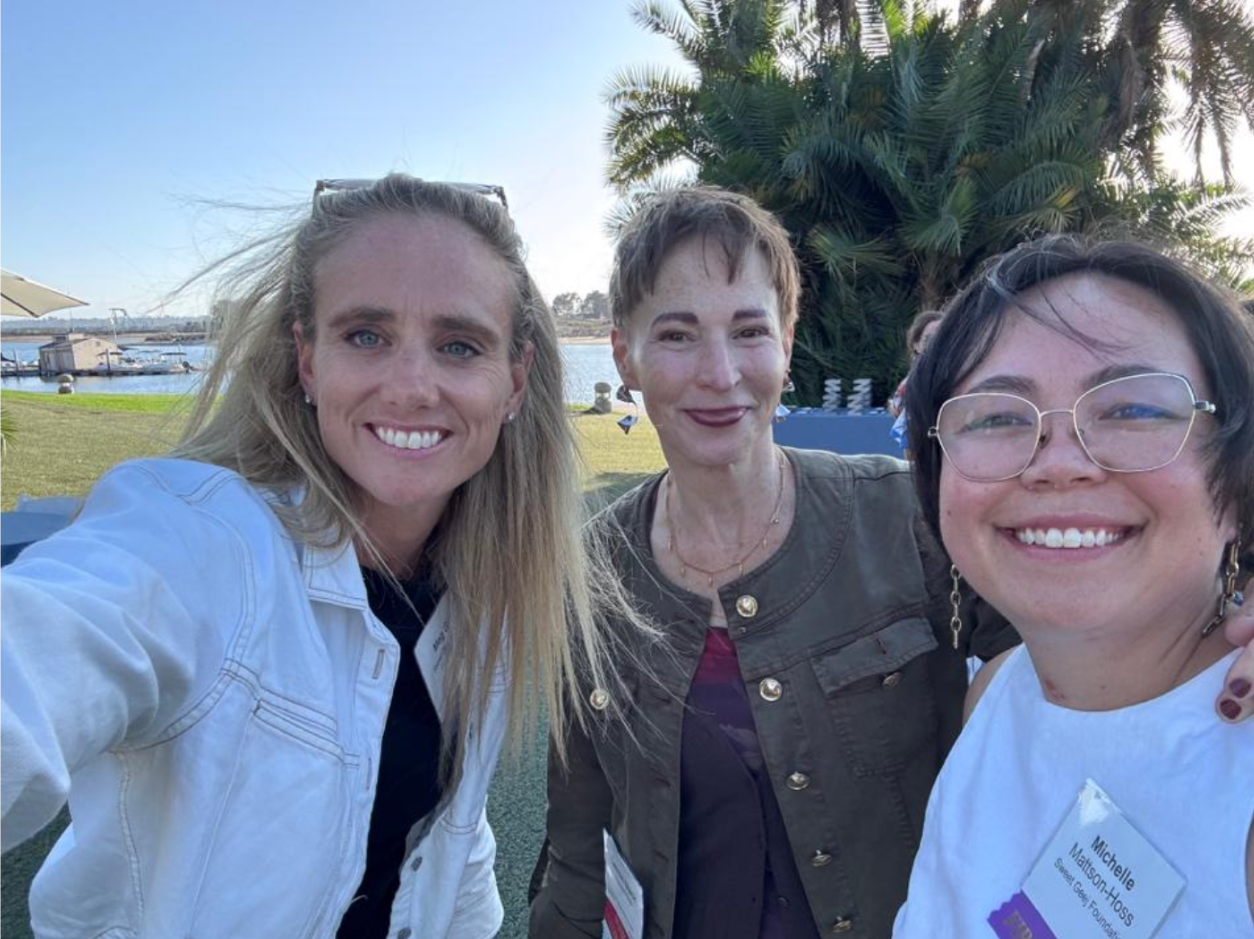
(Meg with Dr. Lauren Black of Charles River Laboratories and Dr. Michelle Mattson-Hoss of Sweet Geej Foundation)
In Closing:
I have cried more in the past year than ever before in my life — out of joy, and out of love. I cried when Jeff Milton said yes to helping design an upregulating ASO when so many others had said no. I cried, harder, when Dr. Kim-McManus said yes to taking on GG's case and becoming her PI. And I cried hardest of all this summer, reading what GG spelled out for us regarding her struggles, her faith, and her hope.
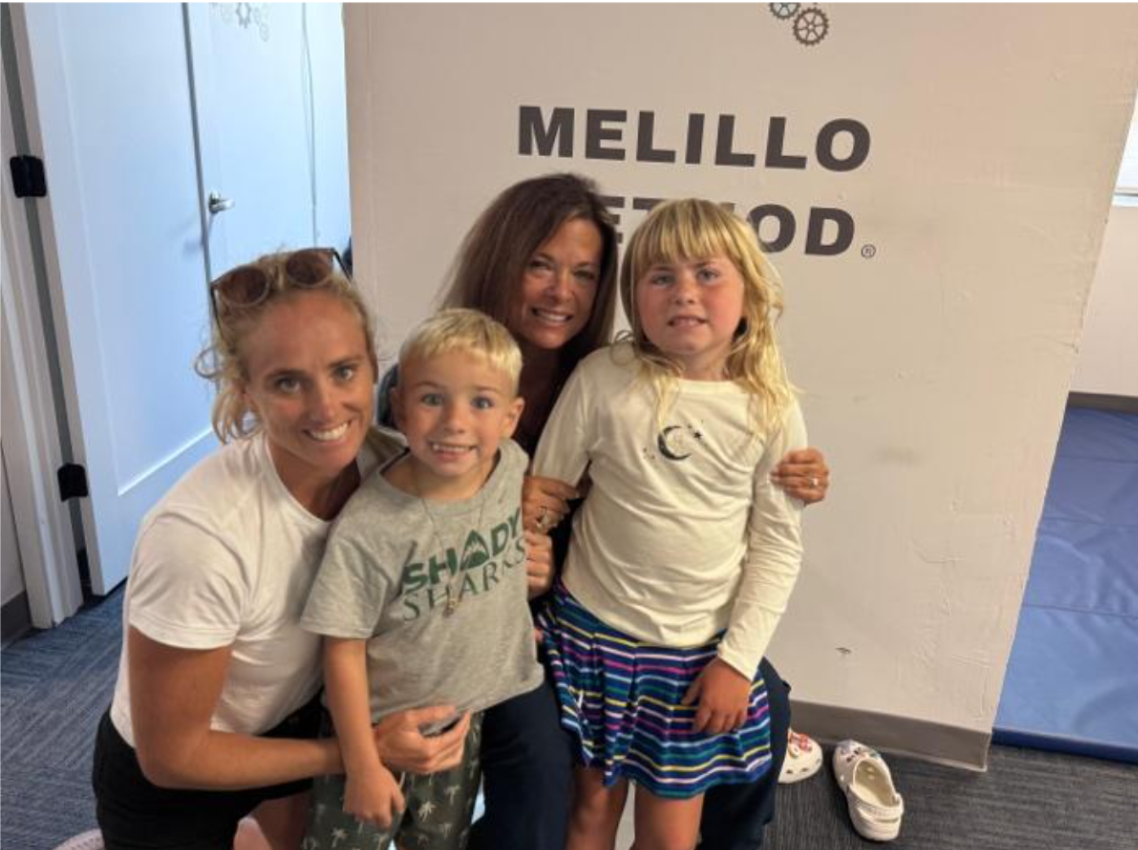
(GG, her brother Grayson, Meg, and Nancy, her tremendous RPM/spelling provider)
I strongly believe that the hope that came with GG's NAA15 diagnosis — and with the idea of an ASO — has given her the strength and motivation to communicate openly with us through her letterboard.
That alone is a miracle, and a gift many nonspeaking children never receive.
So if your child can't yet speak or walk and you've ever wondered about whole genome sequencing, I'd strongly encourage you to have them sequenced — because you never know what miracles may come with the knowledge of a genetic diagnosis.
We still have a long road ahead — additional readouts, a functional assay, GLP toxicology, manufacturing, and sterile fill-and-finish — plus, closer to home, a G-tube surgery next week for our girl. But it has been one hell of a ride so far. And GG is happy to report — spelling, letter by letter, to communicate — that after taking their sweet time to differentiate, her iPSC "cells finally decided to play ball," and that after seven years and so many struggles, she finally has "hope."